
Workers’ Compensation for Knee
Injuries in California
Workers’ Compensation for Knee Injuries

A knee injury can happen in a single moment or develop gradually through physically demanding work. A worker may twist the knee while carrying materials, fall from a ladder, strike the knee against equipment, or experience worsening pain after years of kneeling, climbing, squatting, and lifting.
Workers’ Compensation for Knee Injuries may provide medical treatment and disability benefits when employment causes or contributes to the condition. California Workers Comp Law Firm assists employees with knee injury claims involving disputed medical treatment, work restrictions, wage loss, and disagreements over whether the injury is job-related.
Knee Damage Can Come From Many Different Job Duties
The knee absorbs significant force during walking, lifting, climbing, kneeling, and sudden changes in direction. Workplace injuries can affect ligaments, cartilage, tendons, the kneecap, or surrounding tissues.
A warehouse employee may twist a knee while moving a heavy package. A construction worker can be injured after stepping from uneven scaffolding. A healthcare employee may damage the knee while repositioning a patient, while a delivery driver can be hurt after repeatedly stepping in and out of a vehicle.
Falls are another common source of knee trauma. Workers may slip on wet floors, trip over materials, fall from stairs, or land awkwardly after losing balance. These incidents may also involve other body parts and become part of a broader workplace injury claim.
A Knee Injury Lawyer can review the job activity, mechanism of injury, witness information, and medical findings when the insurance carrier disputes how the condition occurred.
A Knee Condition Does Not Need One Exact Accident Date
Some employees remember precisely when their knee was injured. Others experience symptoms that increase over months or years.
California Labor Code §3208.1 recognizes both specific workplace injuries and cumulative injuries caused by repetitive mentally or physically traumatic activities over time. This distinction can be important for workers who spend much of the day kneeling, climbing, squatting, carrying heavy materials, or repeatedly entering and exiting vehicles.
For example, construction and maintenance employees may perform tasks that place continuous pressure on the knees without experiencing one dramatic accident. Workers in physically demanding trades may need evidence similar to that used in a construction injury claim, including job descriptions, work schedules, physical duties, and medical history.
Workers’ Compensation for Knee Injuries should reflect whether the condition resulted from a sudden event, repetitive work, or a combination of both.
Medical Evidence Must Identify More Than “Knee Pain”
Pain alone does not explain the underlying injury. A physician may need to evaluate swelling, instability, reduced range of motion, weakness, locking, clicking, or difficulty bearing weight.
Depending on the symptoms, medical evaluation may include physical examination, X-rays, MRI imaging, or referral to an orthopedic specialist. Diagnoses may involve meniscus tears, ligament damage, fractures, patellar injuries, tendon problems, or degenerative changes aggravated by work.
The medical history should accurately describe what the worker was doing when symptoms began. Relevant facts include whether the knee twisted, whether the employee fell directly onto it, how much weight was being carried, and whether repetitive kneeling or climbing had occurred over a longer period.
A Workers’ Comp Knee Injury Attorney can review whether medical reports adequately connect the diagnosis with the employee’s actual job duties.
Earlier Arthritis Does Not Automatically Decide the Claim
Insurance carriers sometimes rely on age-related degeneration, arthritis, an earlier sports injury, previous surgery, or prior knee treatment when challenging a workers’ compensation claim.
A pre-existing condition can be relevant, but the analysis does not end there. The question may be whether a workplace accident or repeated job duties caused a new injury or aggravated an existing condition.
Medical evaluators may compare the employee’s condition before and after the workplace event. Evidence can include prior medical records, new diagnostic findings, increased symptoms, additional treatment, and new work restrictions.
Workers facing this issue may also need documentation relevant to an aggravation of a pre-existing condition claim.
A worker who performed full duties before an accident but cannot climb stairs, kneel, or stand for prolonged periods afterward may have an important change that should be documented clearly.
Knee Treatment May Extend Well Beyond the Initial Visit
California Labor Code §4600 requires employers to provide medical treatment reasonably necessary to cure or relieve the effects of a compensable workplace injury.
Treatment depends on the diagnosis and severity of the condition. It may include medication, activity modification, physical therapy, braces, injections, orthopedic evaluation, diagnostic imaging, or surgery when medically appropriate.
A torn meniscus or damaged ligament may require different treatment from a minor strain. Serious injuries can also affect surrounding muscles and the worker’s overall mobility.
A Knee Injury Workers’ Compensation Lawyer can review treatment disputes when the claims administrator delays, modifies, or denies recommended care.
Workers should preserve medical reports, imaging results, treatment requests, authorization decisions, and work-status notes. These records may become especially important when the carrier accepts the initial injury but disputes later treatment or surgery.
Work Restrictions Need to Match the Employee’s Real Duties
Knee injuries can affect much more than walking. A treating physician may restrict kneeling, squatting, climbing, prolonged standing, lifting, running, driving, or work on uneven surfaces.
Those restrictions should be compared with the actual position offered by the employer.
A warehouse worker may technically be given “light duty” while still being expected to walk long distances or climb steps. A maintenance employee may be unable to kneel while completing repairs. A delivery driver with knee restrictions may struggle with repeated vehicle entry, stairs, and package handling.
Workers employed in logistics or industrial settings may face similar return-to-work issues in forklift injury claims when knee movement is necessary to operate equipment safely.
Written medical restrictions, modified-duty offers, job descriptions, and employer communications should be preserved when there is disagreement over whether a proposed assignment is appropriate.
Disability Benefits May Apply During Recovery
A knee injury can prevent an employee from performing usual duties for weeks or months. California workers’ compensation may provide temporary disability benefits when the treating physician determines that the employee cannot perform the regular job and applicable requirements are satisfied.
Permanent disability may become relevant when the worker is left with lasting impairment after the condition stabilizes.
A serious knee injury can permanently affect strength, stability, range of motion, and the ability to kneel or climb. These limitations may be particularly significant for employees whose jobs depend on frequent movement, heavy lifting, or work at height.
Workers’ Compensation Knee Injury Claims should therefore document not only the diagnosis but also how the condition affects the employee’s actual ability to work.
Insurance Companies May Challenge the Cause or Severity
An insurer may argue that the worker suffered only a temporary strain rather than a more significant knee injury. It may challenge whether a meniscus tear resulted from the workplace incident or whether degenerative findings existed beforehand.
Other disputes can involve delayed symptoms, surgery recommendations, work restrictions, disability periods, or whether a second body part was injured because the worker changed the way they walked.
Workers’ Compensation for Knee Injuries can become especially complicated when early medical notes are incomplete. A worker who initially reports only pain may later receive imaging that identifies structural damage.
A Work-Related Knee Injury Lawyer can compare the insurer’s position with the accident report, diagnostic studies, medical records, witness statements, photographs, job duties, and the worker’s symptom history.
Serious Falls Can Involve More Than the Knee
A significant fall may injure the knee along with the back, shoulder, head, or other body parts. Workers should identify every symptom rather than focusing only on the most painful injury during the first medical visit.
For example, landing awkwardly after a fall may injure the knee while also causing spinal symptoms. If back pain later includes numbness, weakness, or radiating symptoms, the employee may require additional evaluation for a herniated disc injury.
Multiple injuries can affect treatment plans, work restrictions, and the length of recovery. The claim record should accurately identify all affected areas.
Preserve the Facts Before the Claim Becomes Disputed
Employees should report knee injuries promptly and document the circumstances carefully.
For a sudden accident, preserve photographs, witness names, incident reports, surveillance information, and details about the surface, equipment, or object involved. For cumulative conditions, record the tasks performed, frequency of kneeling or climbing, lifting requirements, and when symptoms began to interfere with work.
Keep copies of the DWC-1 claim form, medical reports, imaging results, disability notices, work restrictions, and correspondence from the claims administrator.
Employees injured in industrial or production settings may also need records concerning machinery, workstations, and physical duties addressed in factory worker injury claims.
Legal Review Can Connect the Medical and Workplace Evidence
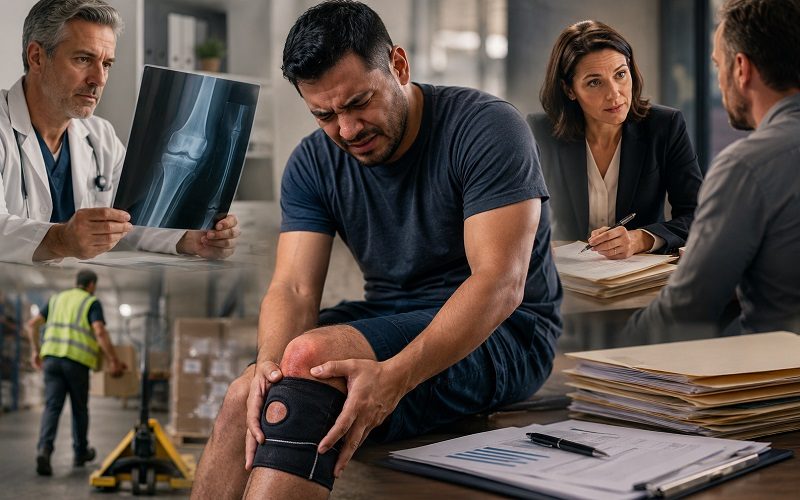
A knee claim may begin with a simple accident report but later involve diagnostic imaging, treatment disputes, modified duty, disability payments, and questions about prior medical conditions.
Workers’ Compensation for Knee Injuries requires the medical history and workplace evidence to describe the same event or pattern of work activity.
A Knee Injury Workers’ Compensation Lawyer can review the injury report, medical findings, job duties, treatment decisions, work restrictions, and insurance response. Legal review may also address denied claims, qualified medical evaluations, disability disputes, and proceedings within California’s workers’ compensation system.
California Workers Comp Law Firm assists employees with knee injuries caused by falls, lifting, repetitive work, industrial accidents, and other workplace hazards.
Contact California Workers Comp Law Firm to request a case evaluation and discuss the evidence relevant to your California knee injury claim.
Important Resources
- California recognizes both specific workplace injuries and cumulative injuries caused by repetitive traumatic activities. California Labor Code §3208.1
- Employers must provide medical treatment reasonably necessary to cure or relieve the effects of a compensable workplace injury. California Labor Code §4600
- California DWC explains injury reporting, medical care, disability benefits, and the workers’ compensation process. DWC Injured Worker Guidance
- California DWC provides information about returning to work and following medical restrictions after an occupational injury. DWC Return-to-Work Guidance
- MedlinePlus provides medical information about common knee injuries and disorders, including ligament, cartilage, and tendon conditions. MedlinePlus Knee Injuries and Disorders
Reviewed by Attorney Mak
Workers’ Compensation Attorney
Attorney Mak reviews workers’ compensation content for California Workers Comp Law Firm. The firm assists California employees with knee injuries, medical treatment disputes, disability issues, work restrictions, denied benefits, and other work-related injury matters.
Get A Free Consltation
Fill out the form below and one of our injury specialists will contact you shortly

