
Uber Driver Injury Lawyer
in California
Workers’ Compensation for Uber Drivers
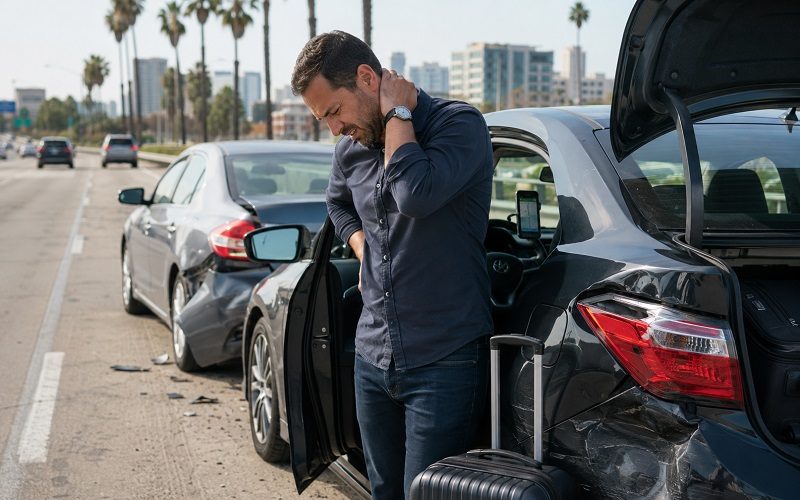
Uber drivers spend hours in traffic, enter and exit vehicles repeatedly, assist passengers with luggage, and work around unpredictable road conditions. A rear-end collision can cause an immediate injury, while prolonged driving, repeated lifting, or an earlier condition aggravated by an accident can create medical problems that continue long after the ride ends.
An Uber Driver Injury Lawyer can review when the accident occurred, whether the driver was logged into the app, what insurance applied, and whether another driver or company may be responsible. California Workers Comp Law Firm evaluates work-related injury issues involving California drivers, medical evidence, disability, and disputed employment status.
Proposition 22 Changes the Usual Workers’ Compensation Analysis
Workers’ Compensation for Uber Drivers requires a different analysis from a traditional employee injury claim. California Business and Professions Code §7451 provides that an app-based driver is treated as an independent contractor rather than an employee of a network company when the statutory conditions are satisfied. Those conditions concern matters such as control over login hours, acceptance of ride requests, work for competing platforms, and other employment.
That classification matters because traditional workers’ compensation generally applies to employees rather than true independent contractors. California DWC also cautions that simply calling a worker an independent contractor does not always decide the issue; worker status depends on the applicable law and facts.
For qualifying app-based drivers, Proposition 22 established occupational accident insurance instead of ordinary employee workers’ compensation coverage for the network-company relationship. A California Uber Driver Injury Lawyer can examine which system applies rather than assuming that every driver injury follows the same claims process.
Occupational Accident Coverage Depends on App Status
California Business and Professions Code §7455 requires a network company to carry or make available occupational accident insurance for injuries suffered while an app-based driver is online with the platform. The statute requires coverage for medical expenses and lost income, subject to its terms and minimum coverage requirements.
The law defines “online” to include periods when a driver is using the platform and can receive ride or delivery requests, as well as engaged time. It also contains limitations for accidents occurring outside engaged time when the driver is performing personal activities or is engaged through another platform.
That makes digital records important. App logs, ride requests, trip histories, timestamps, GPS information, and communications with the platform can help establish whether the driver was online, waiting for a request, traveling to pick up a passenger, or transporting someone when the accident occurred.
A Uber Driver Injury Lawyer can compare those records with the accident report and insurance position when coverage depends on exactly what the driver was doing at the time.
A Traffic Crash Can Produce Several Different Claims
An Uber driver may be injured when another motorist rear-ends the vehicle, runs a red light, changes lanes unsafely, or causes a collision at an intersection. The driver may suffer neck injuries, back pain, shoulder damage, fractures, head trauma, or multiple injuries at once.
The legal issues may involve more than one source of insurance. Occupational accident coverage may be relevant to the driver’s own injuries, while an at-fault motorist may create a separate third-party liability issue. Automobile insurance requirements can also vary depending on whether the driver was merely online or actively engaged in a ride.
Drivers with injuries similar to those experienced by other professional motorists can review information about work-related driving injuries and the importance of connecting medical evidence with the actual event.
Photographs, collision reports, witness information, vehicle damage, dash-camera footage, app records, and medical records should be preserved whenever possible.
Back, Neck, and Shoulder Problems May Appear After the Collision
Pain does not always reach its full intensity at the accident scene. A driver may initially feel capable of going home and develop significant stiffness, numbness, weakness, or restricted movement hours later.
Medical providers should receive an accurate description of the collision, the direction of impact, symptoms, affected body parts, and any changes that occurred afterward. When back pain radiates into a leg or neck symptoms extend into an arm, further evaluation may identify conditions such as a work-related herniated disc.
An Uber Driver Injury Lawyer may review whether early medical records match the later diagnosis. Insurance carriers often compare the first treatment note with later complaints when deciding whether a condition is related to the crash.
Drivers should avoid minimizing symptoms during early treatment. Medical records are more useful when they accurately identify all affected body parts and explain how the condition affects driving, sitting, lifting, sleeping, and other daily activities.
Long Hours Behind the Wheel Can Complicate Medical Causation
Not every driver injury begins with a major collision. Prolonged sitting, repeated vehicle entry and exit, frequent twisting, luggage handling, and long periods behind the wheel may contribute to musculoskeletal symptoms.
A driver may also have arthritis, a prior disc problem, an earlier shoulder injury, or another condition before the incident. The existence of an earlier diagnosis does not by itself explain what changed after a new accident.
Medical evaluators may need to compare the driver’s condition before and after the event. Evidence involving an aggravation of a pre-existing condition can include earlier medical records, new imaging, changes in treatment, increased symptoms, and new work restrictions.
The important question is not simply whether a condition existed before. The medical record should explain whether the accident or driving activity caused new harm, aggravated the prior condition, or created a new need for treatment.
Driver Status Can Become the Central Dispute
Uber Driver Workers’ Compensation Claims can become complicated when the injured person performs several kinds of work. A driver may use multiple apps, work a separate employee job, make deliveries for another company, or drive commercially under a different arrangement.
An injury occurring during employee work may fall under California’s traditional workers’ compensation system even though the same person also drives for Uber as an independent contractor. California DWC notes that employee status and independent-contractor status must be evaluated under the applicable circumstances rather than relying only on a label.
A driver injured while performing duties as an employee can review the broader rules governing a California workplace injury claim.
A careful review should identify who the driver was working for, which application was active, whether a passenger request had been accepted, what other work was being performed, and which insurance policies applied.
Severe Injuries Can Affect the Ability to Keep Driving
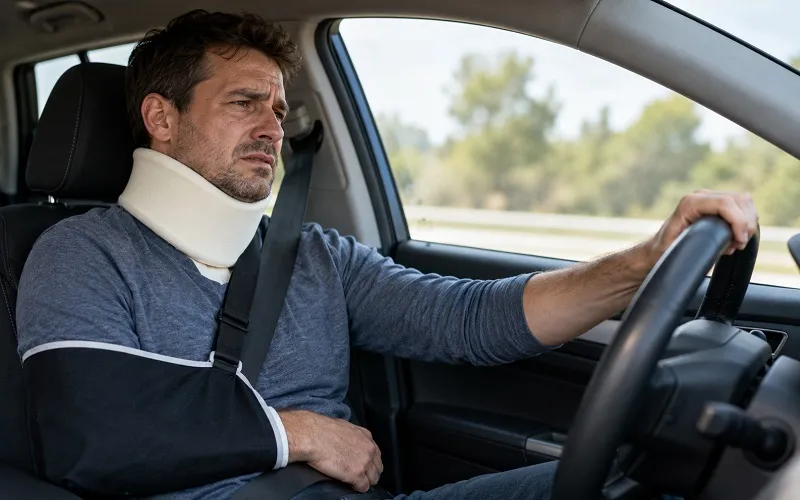
Driving requires more physical ability than simply sitting in a seat. A driver must turn the head to check traffic, operate pedals safely, grip and steer the vehicle, enter and exit repeatedly, and remain alert for long periods.
A physician may restrict driving, lifting, prolonged sitting, repetitive arm use, or other activities after a serious accident. Medication may also affect whether driving is medically appropriate.
Severe spinal injuries, head trauma, multiple fractures, or permanent neurological damage can create long-term consequences addressed in catastrophic workplace injury claims.
Work and earnings records are also important when an injury prevents the driver from returning to the platform. Proposition 22’s occupational accident insurance provisions include disability payments based on defined average weekly earnings, subject to statutory requirements and policy terms.
Keep the App Record Alongside the Medical Record
A strong injury file should document both the medical consequences and the driver’s status when the event occurred.
Drivers should preserve screenshots of their app status, trip history, ride acceptance information, earnings records, communications with Uber, photographs, police reports, witness information, medical records, and insurance correspondence. If the accident happened while traveling to a passenger, the accepted ride and pickup information may be especially important.
For Uber Driver Workers’ Compensation Claims or occupational accident disputes, an incomplete timeline can make it harder to determine which coverage applies.
Drivers should also document subsequent symptoms, medical restrictions, missed driving time, and changes in their ability to perform normal tasks rather than relying only on the information collected at the collision scene.
Legal Review Can Identify Which Claim Process Applies
The first question after an app-based driving injury is often not simply who caused the accident. It may be necessary to determine whether Proposition 22 occupational accident coverage applies, whether the driver had employee status through another job, whether automobile liability coverage is available, and whether another motorist or business bears responsibility.
An Uber Driver Injury Lawyer can review app activity, the collision timeline, medical findings, insurance documents, employment relationships, and evidence of lost earnings.
California Workers Comp Law Firm can also examine whether a driver’s circumstances raise a genuine employee-classification question or overlap with another work injury claim.
Contact California Workers Comp Law Firm to request a case evaluation concerning an Uber driving accident, disputed occupational accident benefits, employment-status issue, or another work-related driving injury.
Important Resources
- California law sets conditions under which an app-based driver is classified as an independent contractor rather than an employee of the network company. California Business and Professions Code §7451
- Proposition 22 requires qualifying network companies to provide occupational accident insurance for covered app-based driver injuries. California Business and Professions Code §7455
- California DWC explains how employee and independent-contractor status can affect workers’ compensation coverage. DWC Workers’ Compensation FAQs
- California DWC provides information about benefits and procedures for employees injured at work. DWC Injured Worker Guidance
- The California Supreme Court upheld Proposition 22’s challenged app-based driver classification provision in Castellanos v. State of California. California Supreme Court – Castellanos
Reviewed by Attorney Mak
Workers’ Compensation Attorney
Attorney Mak reviews workers’ compensation content for California Workers Comp Law Firm. The firm assists California workers with employment-status questions, work-related driving injuries, disputed benefits, medical issues, and other workplace injury matters.
Get A Free Consltation
Fill out the form below and one of our injury specialists will contact you shortly

