
California Burn Injury
Attorney
Burn injury attorney

A workplace burn can change a person’s ability to work in seconds. Hot oil, steam, live electrical equipment, corrosive chemicals, an explosion, or smoke from a fire can damage skin, nerves, muscles, lungs, and joints.
A burn injury attorney reviews the medical record and the events that caused the injury. The investigation must account for the source of the burn, the condition of the worksite, the treatment provided, and the effect of the injury on the employee’s ability to perform regular duties.
California Workers Comp Law Firm represents California employees in workers’ compensation matters involving fires, electrical events, heated equipment, explosions, and chemical burns.
The First Record of the Injury
The first concern after a serious burn is medical treatment. The American Burn Association recommends immediate consultation with consideration for transfer for full-thickness burns, deep burns involving the face, hands, feet, genital area, perineum, or major joints, and suspected inhalation injuries. Its guidance also addresses all chemical injuries and high-voltage electrical injuries.
Medical staff need a precise account of the event. The record should identify the heat source, chemical, voltage, smoke conditions, protective equipment, length of contact, and any fall or loss of consciousness. Burns caused by fire can accompany smoke inhalation, while electrical contact can produce deeper tissue damage than the surface wound suggests.
The worker should report the injury promptly and preserve emergency records, work restrictions, photographs, and incident reports. Dated images are especially useful when the wound changes during healing.
Thermal, Chemical, and Electrical Burns
Restaurant employees work around boiling liquids, grease, ovens, and steam. Construction crews encounter welding, electrical lines, roofing materials, fuel, and cutting equipment. Manufacturing and warehouse jobs involve batteries, heated machinery, pressure systems, and flammable products.
An arc flash deserves separate attention. OSHA describes arc flash as a serious electrical hazard and notes that many arc-flash burn injuries result when the event ignites clothing. Electrical incidents can also involve shock, explosion, falls, and injuries beneath the skin.
A fire injury attorney reviewing the accident examines emergency findings, respiratory complaints, neurological symptoms, and follow-up treatment rather than focusing only on the visible burn.
What the Accident Scene Can Prove
A workplace is often repaired or cleaned soon after a fire or explosion. Photographs and video can show damaged wiring, missing guards, leaking containers, blocked exits, failed alarms, burned clothing, or the position of the equipment involved.
Maintenance logs, inspection reports, training records, safety data sheets, and witness statements help explain whether the hazard existed before the injury. A construction accident can also involve records held by a general contractor, subcontractor, equipment owner, or property manager.
The medical record and site evidence should match. A report that identifies the burn source, body parts affected, treatment, and work limitations carries more value than a generic note stating only that an employee was burned at work.
Treatment Is About Function, Not Only Healing
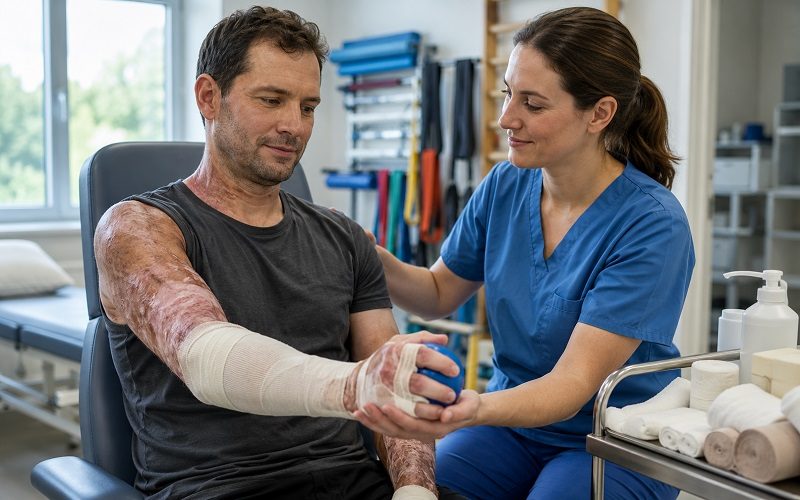
California Labor Code §4600 requires an employer to provide medical treatment reasonably required to cure or relieve the effects of a covered work injury. Burn care can include hospitalization, wound management, surgery, skin grafting, medication, physical therapy, occupational therapy, and treatment for respiratory injury.
A closed wound does not always restore function. Scar tissue across a hand, elbow, knee, shoulder, or ankle can restrict grip, reach, lifting, standing, or walking. Nerve damage can cause numbness, sensitivity, weakness, or chronic pain. Facial burns can affect vision, breathing, and appearance.
Work restrictions should describe what the employee can safely do. California workers’ compensation provides medical care and, when supported by the claim and medical findings, temporary or permanent disability benefits and return-to-work assistance.
A Third Party May Share Responsibility
California’s workers’ compensation system generally provides benefits for covered employment injuries without requiring proof that the employer was negligent. Labor Code §3600 sets out the conditions for compensation when an injury arises out of and occurs in the course of employment.
A different issue arises when someone other than the employer caused the burn. Labor Code §3852 preserves an injured employee’s right to bring an action against a third party. Examples include defective electrical equipment, unsafe machinery supplied by a vendor, careless work by an outside contractor, or a dangerous condition controlled by a property owner.
When the Carrier Minimizes the Burn
A carrier can accept that an accident occurred while disputing the seriousness of the injury. Common disagreements concern specialist treatment, time away from work, permanent scarring, nerve symptoms, smoke inhalation, future care, or whether modified duty complies with medical restrictions.
Photographs taken throughout recovery, burn-center records, operative reports, therapy measurements, respiratory testing, and detailed restrictions provide a clearer account of the injury’s effect. A worker facing a delay or denial can challenge denied workers’ compensation claims through California’s system.
Get Help After a Workplace Burn
If you suffered a burn caused by fire, electricity, chemicals, hot liquids, steam, or industrial equipment at work, you may be entitled to workers’ compensation benefits.
California Workers Comp Law Firm can review the accident, medical evidence, work restrictions, insurance response, and whether another company may share responsibility.
Contact California Workers Comp Law Firm today to request a case evaluation.
Related Workplace Injury Claims
Important Resources
- California workers’ compensation generally applies without proof of employer negligence when the statutory conditions are satisfied. California Labor Code §3600
- Employers must provide treatment reasonably required to cure or relieve the effects of a covered workplace injury. California Labor Code §4600
- A workers’ compensation claim does not eliminate a potential action against a responsible third party. California Labor Code §3852
- The American Burn Association publishes referral guidance for deep burns, critical body areas, inhalation injuries, chemical injuries, and electrical injuries. Guidelines for Burn Patient Referral
- OSHA provides workplace guidance on arc-flash hazards and electrical burn prevention. Electric-Arc Flash Hazards
Reviewed by Attorney Mak
Workers’ Compensation Attorney
Attorney Mak reviews workers’ compensation content for California Workers Comp Law Firm. The firm assists California employees with workplace burn injuries, denied benefits, medical disputes, and related workers’ compensation matters.
Get A Free Consltation
Fill out the form below and one of our injury specialists will contact you shortly

