
Aggravation of Pre-Existing
Condition Lawyer
Aggravation & Pre-Existing Condition
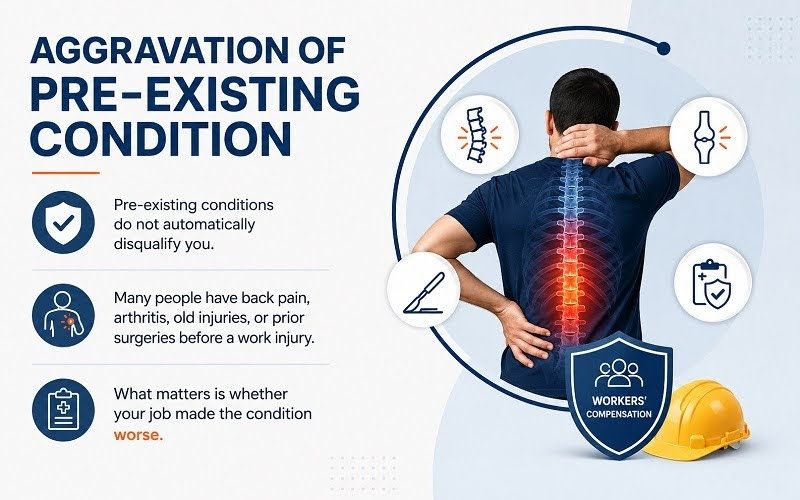
An old injury, arthritis, previous surgery, or another medical condition does not automatically prevent an employee from receiving California workers’ compensation benefits. An Aggravation of Pre-Existing Condition claim focuses on what happened at work and how the employee’s symptoms, treatment needs, restrictions, or work ability changed afterward.
An aggravation occurs when a workplace accident or repeated duties make an earlier medical problem worse, causing new symptoms, additional treatment, work restrictions, or an inability to continue regular duties.
When an Old Condition Becomes a New Work Injury
A pre-existing condition is a health problem that existed before the current workplace injury. It may have required treatment or remained stable for years.
These claims commonly involve back and neck injuries, arthritis, prior surgery, and joint problems. An earlier diagnosis does not prove that it caused the employee’s present disability.
An employee may have occasional lower-back stiffness yet continue working. If a forceful lift later causes leg numbness and reduced movement, the new symptoms must be evaluated alongside the earlier condition.
One Accident or Repeated Strain
Some injuries begin with a fall, heavy lift, sudden twist, equipment incident, or work-related vehicle collision. A forklift accident can worsen an existing back, neck, knee, or shoulder problem.
Other conditions develop through repeated lifting, kneeling, climbing, gripping, pushing, or pulling. California Labor Code Section 3208.1 recognizes specific injuries caused by one incident or exposure and cumulative injuries caused by repetitive physical or mental trauma over time.
Flare-Up Versus Work-Related Aggravation
A return of familiar symptoms is not always a new work injury. A temporary flare-up generally settles and leaves the employee near the same level of health and function as before.
An Aggravation of Pre-Existing Condition creates a more meaningful change. It can increase disability, create a new need for treatment, or require a change in existing treatment. New numbness, weakness, loss of movement, additional restrictions, or previously unnecessary care can show that the condition worsened.
The doctor should compare earlier symptoms and work ability with the problems that followed the incident.
Evidence, Older Records, and the QME Process
A well-supported Aggravation of Pre-Existing Condition claim presents a clear before-and-after account. Earlier records show whether the employee was receiving treatment, missing work, or working under restrictions. Later records should document new symptoms, diagnostic findings, additional treatment, time away from work, and modified-duty instructions.
Accident reports, witness accounts, written restrictions, and an accurate job description add context. Workers should disclose previous injuries and treatment because an incomplete history can create credibility disputes.
Insurance carriers often request older records involving the same body part. They may argue that the current disability resulted from natural progression. Those records can also support the employee by showing that treatment ended, symptoms were controlled, or full duty resumed before the new injury.
A qualified medical evaluator may review relevant older records. The claims administrator must provide the employee with a copy of the information it plans to send to the QME at least 20 days before sending it. An MRI may confirm degeneration, but it does not explain when the condition became disabling.
Apportionment and Permanent Disability
Apportionment concerns the causes of permanent disability. It does not automatically determine whether a workplace injury occurred.
California Labor Code Section 4663 requires a physician to estimate the approximate percentage of permanent disability caused by the current industrial injury and the percentage caused by other factors, including prior injuries or medical conditions. The report must explain how each factor caused disability and why the percentages are medically reasonable.
Reporting the Injury and Receiving Treatment

Report a specific accident promptly. When symptoms develop gradually, notify the employer once there is reason to believe work caused or worsened the condition. Failing to report within 30 days can place benefits at risk, particularly when the delay prevents investigation.
For an injury causing lost time beyond the employee’s shift or requiring medical treatment beyond first aid, the employer must provide or mail a DWC-1 claim form within one working day after receiving notice or knowledge of the injury.
After the employee files the DWC-1 form, the claims administrator must authorize appropriate medical treatment within one working day while the claim is investigated. Treatment provided before the claim is accepted or rejected is limited to a total of $10,000.
An accepted claim can provide medical care, temporary disability, permanent disability, and supplemental job displacement benefits.
When the Insurance Company Challenges the Claim
A carrier may deny that work contributed to the condition, rely on an older diagnosis, or dispute treatment, disability, or apportionment. An attorney can review whether the evaluator received the complete history and an accurate description of the employee’s duties.
A denial does not necessarily end the matter. An employee can challenge a denied workers’ compensation claim through the California system. Some disputes require proceedings before the Workers’ Compensation Appeals Board or a workers’ compensation appeal.
Speak With California Workers Comp Law Firm
California Workers Comp Law Firm handles disputed workers’ compensation matters involving prior injuries, aggravated medical conditions, and denied benefits.
If an insurer is challenging an Aggravation of Pre-Existing Condition claim, the earlier history should be compared fairly with the symptoms, restrictions, treatment, and work ability that followed the new injury.
Attorney Mak can review the workplace accident, prior medical records, current treatment, and apportionment issues. Contact California Workers Comp Law Firm to request a case evaluation.
Related Workplace Injury Claims
Important Resources
- Specific and cumulative injuries are recognized under California law. Labor Code § 3208.1
- Permanent disability can be divided between work-related and non-work-related causes. Labor Code § 4663
- DWC explains aggravation versus a temporary flare-up. DWC physician guidance
- DWC covers reporting, DWC-1 timelines, and the $10,000 treatment limit during claim investigation. Workers’ compensation guidance
- DWC provides guidance on QME records and medical information. QME guidance
Reviewed by Attorney Mak
Workers’ Compensation Attorney
Attorney Mak assists injured workers with California workers’ compensation claims, including workplace injuries, pre-existing condition disputes, denied benefits, and related workers’ compensation matters.
Get A Free Consltation
Fill out the form below and one of our injury specialists will contact you shortly

